AMD FSR 4 vs DLSS 4: Which Is Better for PC Gaming
AMD FSR 4 and NVIDIA DLSS 4 represent the latest generation of AI upscaling technologies, each offering distinct advantages for PC gamers seeking better performance without sacrificing visual quality.
AMD FSR 4 vs DLSS 4: Which Is Better for PC Gaming
The battle between AMD FSR 4 and DLSS 4 has intensified as both companies push their AI upscaling technologies to new heights. These competing solutions promise to deliver higher frame rates without compromising visual quality, but each takes a different approach to achieving this goal. Understanding the strengths and limitations of FSR 4 versus DLSS 4 will help you choose the right technology for your gaming setup.
Performance Comparison: Speed vs Quality Trade-offs
FSR 4 consistently delivers faster performance than DLSS 4 in most gaming scenarios. The technology achieves this speed advantage through its more efficient processing pipeline, which requires less computational overhead than NVIDIA's transformer-based AI model. In demanding titles at 1440p resolution, FSR 4 often provides 5-15% higher frame rates compared to DLSS 4 when both are set to their respective Quality modes.
However, DLSS 4 compensates for its slightly lower raw performance with superior image reconstruction quality. The transformer AI model excels at preserving fine details and reducing temporal artifacts, particularly in scenes with complex geometry or fast-moving objects. This creates a trade-off where FSR 4 offers better raw performance while DLSS 4 provides cleaner visual output.
For competitive gaming where frame rate matters most, FSR 4's performance advantage can provide a meaningful edge. For single-player games where visual fidelity is paramount, DLSS 4's superior image quality may be worth the slight performance cost.
Image Quality Analysis: Sharpness and Artifact Handling
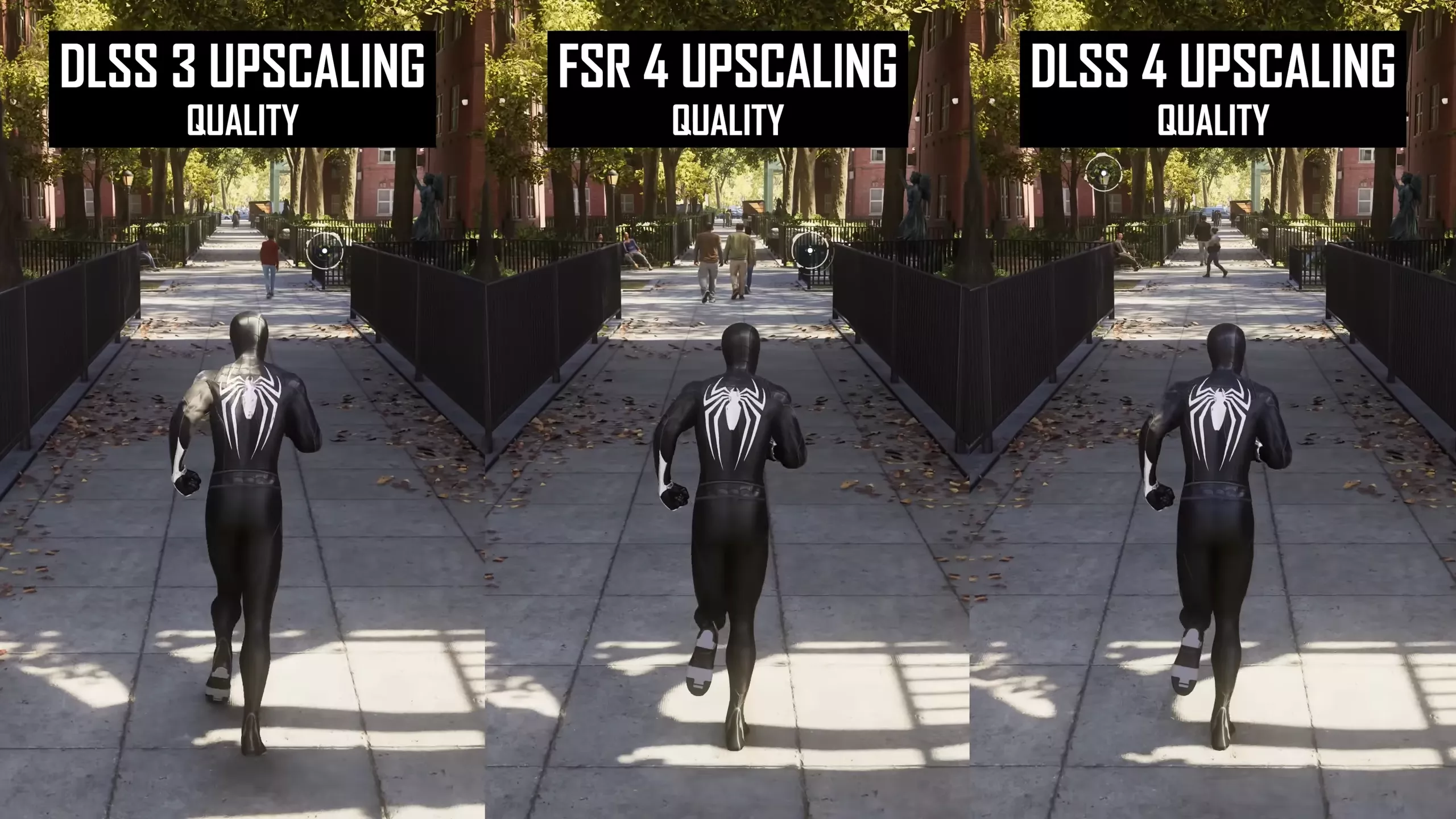
DLSS 4 produces sharper images with better detail preservation compared to FSR 4. The technology's advanced AI training allows it to reconstruct fine textures and maintain edge definition more effectively. In games like Cyberpunk 2077, DLSS 4 renders hair, foliage, and architectural details with greater clarity, especially when viewed at native resolution.
FSR 4 generates a softer overall image but handles certain visual elements better than its predecessor. The technology shows particular improvement in shadow rendering and motion handling, where it can actually outperform DLSS 4 in specific scenarios. Fast-moving objects and particle effects often appear more stable with FSR 4, reducing the shimmer and ghosting artifacts that can affect DLSS implementations.
Game Support and Compatibility
DLSS 4 currently enjoys broader game support due to NVIDIA's established relationships with developers and the technology's longer market presence. Major AAA titles typically receive DLSS integration at launch or shortly after, with over 500 games and applications supporting various DLSS versions.
FSR 4 faces the challenge of catching up in terms of game adoption. While AMD has made significant strides in encouraging developer adoption through open-source availability and easier integration, the technology appears in fewer titles compared to DLSS. However, FSR 4's hardware-agnostic design means it can run on NVIDIA GPUs as well as AMD cards, potentially accelerating adoption rates.
- DLSS 4: Supported on RTX 40-series and newer graphics cards
- FSR 4: Compatible with most modern GPUs from AMD, NVIDIA, and Intel
- Cross-platform support: FSR 4 works across different hardware vendors
- Developer integration: DLSS 4 has more established tooling and documentation
Is AMD FSR 4 Worth Using?
FSR 4 represents a significant improvement over previous FSR versions and delivers competitive results against DLSS 4. The technology excels in scenarios where maximum performance is needed, making it particularly valuable for high refresh rate gaming or when running demanding titles on mid-range hardware.
The choice between FSR 4 and DLSS 4 often depends on your hardware configuration and gaming priorities. AMD GPU owners will naturally gravitate toward FSR 4, while NVIDIA users have the luxury of choosing between both technologies when games support them. The performance advantage of FSR 4 makes it compelling even for NVIDIA users in performance-critical situations.
FSR 4 vs DLSS 3: Generational Improvements
When compared to the previous generation DLSS 3, FSR 4 shows remarkable progress in closing the quality gap. While DLSS 3 still maintained a clear advantage over FSR 3 in most scenarios, FSR 4 matches or exceeds DLSS 3 performance in many titles while delivering comparable visual quality.
This generational leap demonstrates AMD's commitment to AI-driven upscaling technology and suggests that the competition between FSR and DLSS will continue to drive innovation in both camps. The rapid improvement in FSR quality indicates that future versions may close the remaining gaps with DLSS implementations.
QwikTwik's graphics optimization features can help you get the most out of either FSR 4 or DLSS 4 by ensuring your system is properly configured for maximum performance and stability.
Hardware Requirements and System Impact
Both FSR 4 and DLSS 4 require modern graphics hardware to function effectively, but their system requirements differ significantly. DLSS 4 demands RTX-series GPUs with dedicated AI processing units, limiting compatibility to NVIDIA's newer hardware generations.
FSR 4 takes a more inclusive approach, running on a wider range of hardware including older GPUs that lack specialized AI acceleration. This broader compatibility makes FSR 4 accessible to more gamers, particularly those with budget or older systems who still want to benefit from AI upscaling technology.
Future Outlook and Development Trajectory
The competition between FSR 4 and DLSS 4 continues to drive rapid innovation in AI upscaling technology. NVIDIA's established lead in AI processing gives DLSS certain advantages, but AMD's open approach and broader hardware support create different competitive dynamics.
Both technologies will likely see continued refinement through driver updates and new game integrations. The ultimate winner may depend less on pure technical superiority and more on factors like developer adoption, hardware availability, and ecosystem support.
Is AMD FSR 4 worth using over DLSS 4?
FSR 4 is worth using when you need maximum performance or have non-NVIDIA hardware. It delivers competitive image quality with better frame rates, making it excellent for competitive gaming or high refresh rate displays.
Which provides better image quality, FSR 4 or DLSS 4?
DLSS 4 generally provides sharper images with better detail preservation, while FSR 4 offers a softer but more stable image with fewer temporal artifacts in motion-heavy scenes.
Can I use FSR 4 on NVIDIA graphics cards?
Yes, FSR 4 works on NVIDIA graphics cards as well as AMD and Intel GPUs, giving you the option to choose between FSR 4 and DLSS 4 on compatible NVIDIA hardware.
How does FSR 4 compare to DLSS 3?
FSR 4 significantly closes the quality gap compared to DLSS 3, often matching or exceeding DLSS 3 performance while delivering similar visual quality in many games.